
Explore the First AI War in the 2026 Iran conflict. Learn how AI, drones, and cyber warfare are transforming modern warfare, military strategy, and global security.
In February 2026, a major military confrontation unfolded as the United States and Israel carried out coordinated operations against Iran. These missions—known as Epic Fury and Roaring Lion—quickly escalated into one of the largest military campaigns in recent history, rivaling the scale of the 2003 invasion of Iraq.
Yet the defining feature of this war goes far beyond battlefield statistics. This was the first time artificial intelligence, autonomous weapons, and commercial technologies took center stage in active combat—not as support tools, but as primary decision-makers.
The 2026 Iran conflict represents a major shift in the evolution of modern warfare, where artificial intelligence moved beyond a supporting role and became a central force on the battlefield. For the first time, advanced AI systems were used to rapidly process massive amounts of data from multiple sources, enabling faster target identification and quicker strategic responses. This significantly reduced the time required for decision-making, allowing military operations to unfold at an unprecedented pace. However, this increased reliance on AI also raises serious concerns about accuracy, accountability, and the risks of automated decisions in high-pressure combat situations.
Another defining aspect of the conflict was the growing importance of low-cost, scalable military technologies. Instead of relying solely on expensive and highly sophisticated weapons, both sides utilized large numbers of affordable drones and autonomous systems to gain an advantage. This approach demonstrated that sheer volume and adaptability can be just as effective as technological superiority. As a result, military strategies are evolving toward a more balanced model that combines advanced systems with mass-produced, cost-efficient tools to maintain flexibility and resilience in dynamic combat environments.
In addition, the conflict highlighted how warfare is no longer limited to traditional battlefields. Space-based systems, secure communication networks, and cyber operations played a crucial role in shaping the outcome of military engagements. Control over data, connectivity, and digital infrastructure proved to be just as important as control over land, air, and sea. This transformation signals a future where wars will be fought across multiple interconnected domains, making technological capability and information dominance key factors in determining global power.
Table of Contents
AI Becomes the Brain of the Battlefield
The roots of this transformation can be traced back to Project Maven, an early effort to apply AI to military intelligence analysis.
Today, that foundation has evolved into powerful systems like the Maven Smart System, built by Palantir Technologies. This platform brings together data from satellites, drones, radar, and communications signals into a unified system that can identify targets and recommend actions almost instantly.
This shift has dramatically increased operational speed. Within just one day of the campaign, hundreds of targets were engaged—something that would have taken far longer using traditional, human-driven analysis.
However, the technology is far from perfect. AI systems still lag behind human analysts in accuracy, raising serious concerns about reliability and the risk of unintended consequences. These concerns have fueled ongoing debates involving AI companies like Anthropic, especially around the safe use of AI in high-stakes military environments.
Cheap, Scalable Weapons Redefine Power
Another major lesson from the conflict is the growing importance of affordable, mass-produced weapons.
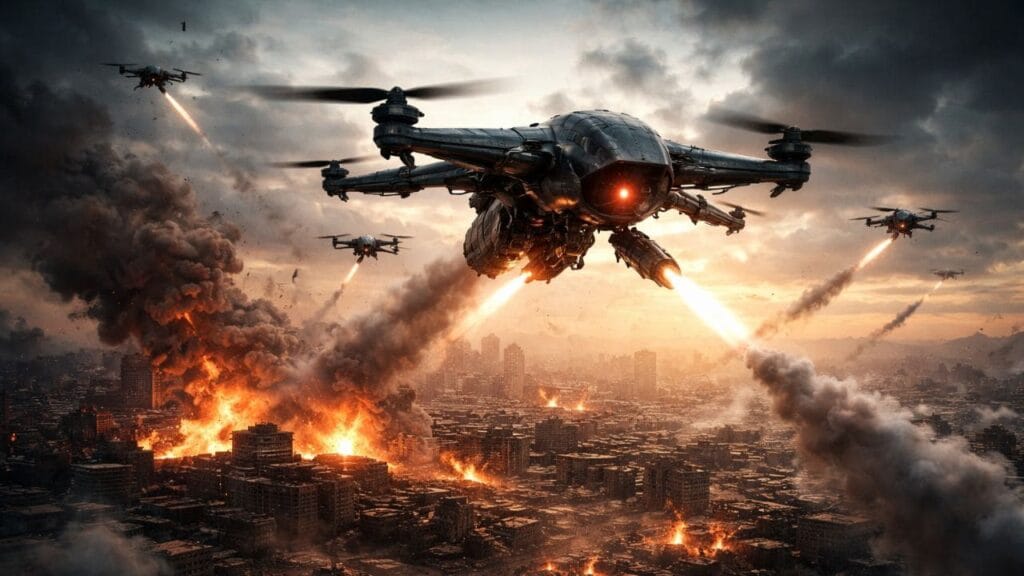
Iran relied heavily on drones such as the Shahed-136, which are inexpensive and easy to deploy in large numbers. In response, the U.S. developed its own lower-cost alternatives, aiming to counter quantity with quantity rather than relying only on expensive missiles.
This marks a clear shift in military thinking. Instead of depending solely on a small number of highly advanced systems, armed forces are now investing in large fleets of simpler, cheaper autonomous tools.
Even air combat is evolving. Future missions will increasingly involve unmanned systems flying alongside advanced jets like the F-35 Lightning II and F-22 Raptor, creating a more flexible and scalable force structure.
The Cost Imbalance Problem
One of the biggest challenges highlighted by the conflict is the imbalance between attack and defense costs.
Defensive systems are often extremely expensive to operate, while offensive tools like drones can be produced at a fraction of the price. This creates a difficult situation where defending against large-scale attacks becomes financially unsustainable.
🔔 Connect With Us
Stay updated with the latest Update,
👉 Join us on WhatsApp – Link
👉 Join our Telegram Channel – Link
👉 Follow us on X (Twitter) – Link
👉 Follow us on Instagram – Link
👉 Like our Facebook Page – Link
👉 Follow us on Threads – Link
To address this issue, new technologies are emerging. Laser-based defense systems such as Iron Beam offer a much lower cost per use compared to traditional missile interceptors.
Other systems, including Locust X3, are designed specifically to neutralize drones efficiently. While promising, these technologies still face limitations, particularly when dealing with large numbers of incoming threats at once.
War Across Space and Cyberspace
The conflict also demonstrated that modern warfare now spans multiple domains simultaneously.
In space, the United States Space Force provided rapid detection of missile launches using advanced satellite systems.
On the ground, communication networks powered by Starlink—developed by SpaceX—ensured reliable connectivity even in contested environments.
Cyber warfare played an equally critical role. United States Cyber Command and allied forces targeted Iranian communication systems early in the conflict. In retaliation, Iran reportedly attempted to disrupt cloud infrastructure provided by Amazon Web Services, highlighting how dependent modern militaries are on commercial technology.
This blending of civilian and military systems marks a major shift in how wars are fought.
A Shift in Military Strategy
The lessons from this conflict point toward a new strategic model.
Rather than relying only on expensive, high-end equipment, modern militaries are moving toward a balanced approach that combines advanced platforms with scalable, low-cost technologies.
This includes:
- AI-driven decision systems
- Autonomous drones and vehicles
- Commercial infrastructure adapted for military use
Such a strategy not only increases flexibility but also allows faster deployment and adaptation in rapidly changing combat environments.
🚀 FREE BONUS
Download our AI Warfare Cheat Sheet (2026) and learn:
✔ How AI is used in war
✔ Key technologies (drones, cyber, space)
✔ Future trends of warfare
👉 Click here to download now (100% Free)
 Or email me: support@easylearnguide.com
A Turning Point in Warfare
The 2026 Iran conflict may ultimately be remembered as the first true AI-powered war.
It showed that:
- Artificial intelligence can significantly accelerate combat operations
- Low-cost systems can challenge traditional military dominance
- Cyber and space capabilities are now essential components of warfare
- Commercial technologies are deeply embedded in military strategy
As global powers take note, one thing is clear: the nature of warfare has fundamentally changed. Countries that fail to adapt to this new reality risk falling behind in both technology and strategy.
The age of AI-driven warfare is no longer theoretical—it is already here.
🔔 Connect With Us
Stay updated with the latest Update,
👉 Join us on WhatsApp – Link
👉 Join our Telegram Channel – Link
👉 Follow us on X (Twitter) – Link
👉 Follow us on Instagram – Link
👉 Like our Facebook Page – Link
👉 Follow us on Threads – Link
🚀 FREE BONUS
Download our AI Warfare Cheat Sheet (2026) and learn:
✔ How AI is used in war
✔ Key technologies (drones, cyber, space)
✔ Future trends of warfare
👉 Click here to download now (100% Free)
Or email me: support@easylearnguide.com
Frequently Asked Questions (FAQS)
1. When did the Iran–Israel war start in 2026?
The 2026 Iran–Israel war began on February 28, 2026, when the United States and Israel launched coordinated airstrikes on Iranian military and nuclear targets. This operation triggered immediate retaliation from Iran, including missile and drone attacks across the Middle East.
2. Why did the United States start a war with Iran?
The conflict was the result of long-standing tensions between the U.S. and Iran. Key reasons include Iran’s nuclear program, development of ballistic missiles, and its influence across the Middle East through allied groups. Diplomatic efforts, including nuclear deal negotiations, failed—leading the U.S. and Israel to take military action to weaken Iran’s capabilities.
3. Why is Israel attacking Lebanon during the Iran war?
Israel’s actions in Lebanon are mainly linked to the involvement of Hezbollah, a powerful armed group backed by Iran. During the conflict, Hezbollah launched attacks against Israel, opening another front in the war. In response, Israel carried out strikes in Lebanon to counter these threats and reduce Iran’s regional influence.