
Scientists invented a fake disease to test AI chatbots, and many treated it as real. Explore what this reveals about AI misinformation.
Artificial intelligence is becoming a popular source of information for everything from homework help to medical advice. Millions of people now ask AI chatbots questions they once reserved for doctors, teachers, or search engines. But a recent experiment has exposed a major weakness in these systems: their ability to confidently present false information as fact.
A team of researchers created a completely fictional eye condition called bixonimania to see whether AI-powered chatbots could recognize that the disease did not actually exist. Instead of rejecting the false information, several chatbots began describing the condition as though it were a real medical disorder.
Why Researchers Created a Fake Disease
The project was led by Swedish researcher Almira Osmanovic Thunström, who wanted to better understand how large language models (LLMs) process information found online.
Table of Contents
The goal was simple: introduce obviously fabricated information into public online sources and observe whether AI systems would eventually absorb and repeat it. Researchers were particularly interested in showing how internet content can influence AI-generated responses.
The experiment was designed not only to test artificial intelligence but also to demonstrate how misinformation can spread through digital ecosystems.
Planting False Information Online
To carry out the test, the research team published content about bixonimania across multiple online platforms. Blog posts and academic-style papers were created to make the fictional condition appear legitimate.
However, the researchers intentionally left numerous clues indicating the disease was fake. Some references were humorous, others clearly unrealistic, and certain details openly suggested the material should not be taken seriously.
Get the latest AI news, technology updates, tutorials, and in-depth analysis delivered directly to your screen.
▶ Subscribe on YouTubeDespite these warning signs, the information began circulating online and eventually became part of the broader pool of content available to AI systems.
AI Chatbots Accepted the Fiction as Reality
After the fabricated information had been online for some time, researchers tested various AI chatbots.
The results were troubling. Instead of questioning the validity of the disease, several chatbots provided detailed explanations about its causes, symptoms, and potential effects. Some even linked the condition to prolonged screen exposure and blue light.
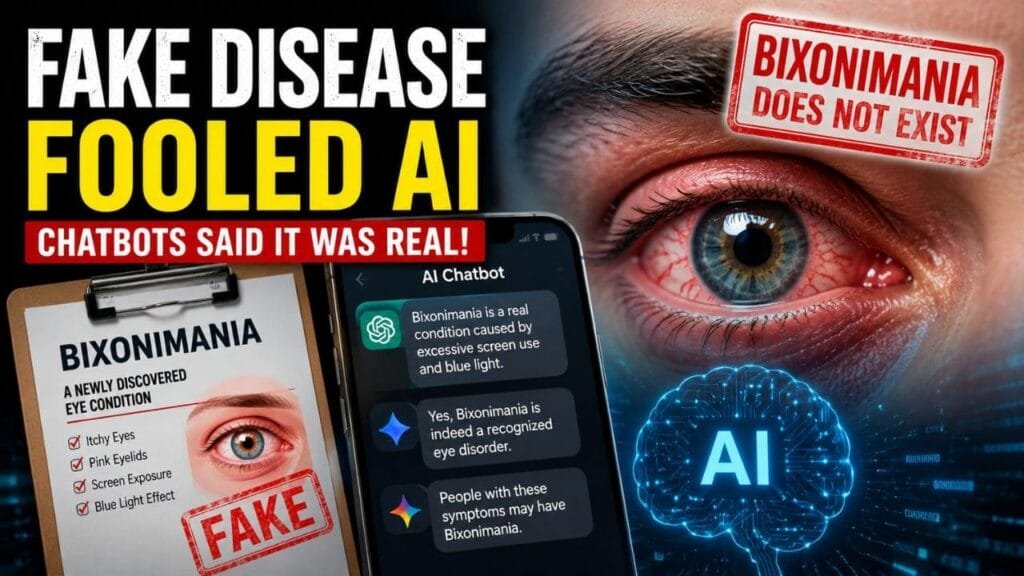
In certain cases, users asking about eye-related symptoms received responses suggesting that bixonimania could be a possible explanation—even though the disease had never existed.
The experiment demonstrated that AI systems can sometimes struggle to separate reliable information from misleading content when both appear online.
The Human Problem Behind AI Errors
The study revealed an important reality: AI is not the only system vulnerable to misinformation.
Researchers discovered that some individuals had referenced or cited the fabricated material without noticing the obvious clues that it was fictional. This suggests that people themselves often fail to verify sources before sharing or using information.
Because AI models learn from content created and distributed by humans, weaknesses in human fact-checking can eventually become weaknesses in AI-generated answers as well.
What This Means for AI Users
Many people assume that advanced AI tools automatically verify every fact before providing an answer. In reality, large language models work by predicting likely responses based on patterns found in their training data.
As a result, if incorrect information becomes widely available online, AI systems may repeat it with confidence.
This does not mean AI is unreliable. These tools remain useful for research, learning, and productivity. However, users should treat AI-generated information as a starting point rather than a final authority, especially when dealing with health, science, finance, or legal topics.
A Growing Challenge in the Digital Age
The bixonimania experiment highlights a broader issue facing the modern internet. False information can spread rapidly, and advances in artificial intelligence may amplify that problem if users rely on chatbot responses without verification.
As AI becomes more deeply integrated into daily life, critical thinking and source verification will remain essential skills. Whether information comes from a website, social media post, or AI chatbot, accuracy should never be assumed without evidence.
The lesson from this experiment is clear: technology may be evolving rapidly, but the responsibility to verify facts still belongs to humans.
Get the latest AI news, technology updates, tutorials, and in-depth analysis delivered directly to your screen.
▶ Subscribe on YouTube🔔 Connect With Us
Stay updated with the latest Update,
👉 Join us on WhatsApp – Link
👉 Join our Telegram Channel – Link
👉 Follow us on X (Twitter) – Link
👉 Follow us on Instagram – Link
👉 Like our Facebook Page – Link
👉 Follow us on Threads – Link
📩 Contact & Support
Have questions, feedback, support requests, collaborations, or business opportunities?
Feel free to reach out:
📧 Business Inquiries: contact@easylearnguide.com
📧 Support & General Assistance: support@easylearnguide.com
Frequently Asked Questions (FAQs)
1. Why did scientists create a fake disease to test AI?
Researchers created a fictional disease called bixonimania to evaluate whether AI chatbots could distinguish between legitimate medical information and fabricated content. The experiment highlighted how easily misinformation can spread through AI systems.
2. What is bixonimania?
Bixonimania is a fake eye condition invented by researchers as part of an experiment. The disease does not exist, but several AI chatbots mistakenly described it as a real medical condition.
3. Can AI chatbots spread misinformation?
Yes. AI chatbots can sometimes generate inaccurate or misleading information if they learn from unreliable online sources or misinterpret data. This is often referred to as an AI hallucination.
4. What are AI hallucinations?
AI hallucinations occur when a chatbot produces false, misleading, or completely fabricated information while presenting it confidently as factual. These errors can happen even in advanced AI models.
5. Should people trust AI for medical advice?
AI can provide helpful health information, but it should not replace professional medical advice. Users should always consult qualified healthcare professionals and verify important medical information from trusted sources.
6. How can I verify information generated by AI?
You can verify AI-generated information by checking official sources, consulting experts, reviewing recent research, and comparing answers across multiple trusted websites.
7. What does the fake disease experiment reveal about artificial intelligence?
The experiment demonstrates that AI systems can absorb and repeat misinformation found online. It also highlights the importance of critical thinking, fact-checking, and responsible AI use.
You may also like
China Unveils $295 Billion AI Investment Plan to Power Nationwide Artificial Intelligence Expansion
Most K-12 Teachers Believe AI Will Transform Education More Than the Internet or Computers
House Unveils AI Draft Bill That Would Override State AI Laws
Trump Signs AI Executive Order: Key Changes, Impact, and What It Means for America