
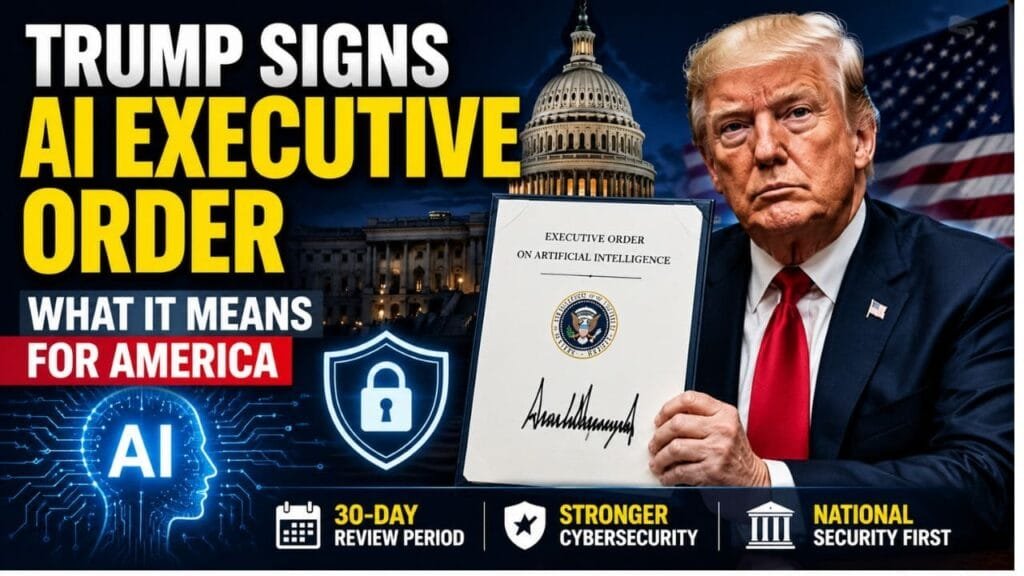
President Trump signs a new AI Executive Order, giving the U.S. government early access to advanced AI models to improve cybersecurity and national security.
President Donald Trump has approved a new executive order focused on artificial intelligence, creating the first major AI policy framework of his second term. The decision follows weeks of internal discussions within the White House over how the federal government should respond to the rapid advancement of AI technology.
The newly signed order introduces a system that allows federal agencies to review certain advanced AI models before they become publicly available. Under the finalized framework, the government will receive access to qualifying AI systems 30 days before their public launch.
Why the White House Moved Forward With the AI Order
The administration had previously delayed a similar proposal after concerns were raised about its potential impact on innovation. However, officials increasingly viewed the lack of a formal framework as a growing risk as artificial intelligence systems become more capable and influential.
Table of Contents
Senior advisers reportedly encouraged Trump to move ahead with a revised plan, arguing that the government needed a structured approach to monitor emerging AI technologies and address possible security concerns before they reached the public.
What the Executive Order Includes
Rather than imposing direct regulations on AI developers, the executive order establishes a cooperative process between government agencies and technology companies.
The policy will help determine which AI systems are considered highly advanced and may require additional review before release. Once identified, those models can be examined by federal experts to assess potential cybersecurity, safety, and national security risks.
Key elements of the order include:
- A 30-day advance review period for selected AI models.
- A government-led process to identify frontier AI systems.
- Limited early access for approved agencies and trusted partners.
- Enhanced cybersecurity measures across federal networks.
- Increased enforcement against criminal misuse of AI technologies.
Administration officials say the approach is designed to support innovation while reducing potential threats posed by increasingly powerful AI tools.
Concerns Over AI and Cybersecurity
One of the main motivations behind the executive order is the growing concern that advanced AI systems could be exploited for malicious purposes.
Security experts have warned that future AI models may be capable of assisting cybercriminals in launching sophisticated attacks against critical infrastructure, government systems, and private organizations. By reviewing advanced models before their public release, officials hope to identify vulnerabilities and strengthen defenses against emerging threats.
Industry Reaction
Several major AI companies have expressed support for the new framework, viewing it as a collaborative effort rather than a restrictive regulatory measure.
Technology leaders have acknowledged that AI capabilities are advancing at an unprecedented pace, making cooperation between government and industry increasingly important. The shortened 30-day review period is also seen as a compromise that reduces the burden on developers while still providing time for security evaluations.
Potential Global Implications
The executive order could also influence future international discussions on AI governance and safety standards.
With a domestic framework now established, U.S. officials may seek conversations with other countries about approaches to managing advanced AI systems and reducing cross-border security risks. Such discussions could play a role in shaping future global standards for artificial intelligence development.
What Comes Next?
Federal agencies have been instructed to begin implementing the order immediately. The Department of Defense will review and strengthen sensitive networks, while the Department of Justice will focus on addressing criminal activities that involve the misuse of AI technologies.
As artificial intelligence continues to evolve, the executive order represents a significant step in the Trump administration’s effort to balance technological innovation, economic competitiveness, and national security.
The policy also signals that AI governance is becoming a major priority for the United States as advanced AI systems play a growing role in business, cybersecurity, and everyday life.
🔔 Connect With Us
Stay updated with the latest Update,
👉 Join us on WhatsApp – Link
👉 Join our Telegram Channel – Link
👉 Follow us on X (Twitter) – Link
👉 Follow us on Instagram – Link
👉 Like our Facebook Page – Link
👉 Follow us on Threads – Link
📩 Contact & Business Inquiries
Have questions, collaborations, or business opportunities?
Feel free to reach out: contact@easylearnguide.com
Frequently Asked Questions (FAQs)
Q1. What is Trump’s AI Executive Order?
Answer: Trump’s AI Executive Order is a federal directive that establishes policies and priorities for artificial intelligence development in the United States. It aims to promote innovation, strengthen U.S. competitiveness, support responsible AI adoption, and guide federal agencies in implementing AI-related initiatives.
Q2. Why did Trump issue an Executive Order on AI?
Answer: Trump issued the Executive Order on AI to accelerate artificial intelligence innovation, enhance economic growth, improve government efficiency, and maintain U.S. leadership in the global AI race. The order also seeks to encourage investment and research in emerging AI technologies.
Q3. What is the U.S. AI Executive Order?
Answer: The U.S. AI Executive Order refers to presidential directives that establish a national strategy for artificial intelligence. These orders guide federal agencies on AI development, adoption, governance, workforce preparation, and national security considerations.
Q4. What is an Executive Order?
Answer: An Executive Order is an official directive issued by the President of the United States to manage operations within the federal government. While it carries the force of law for federal agencies, it cannot override laws enacted by Congress.
Q5. What are the main goals of Trump’s AI policy framework?
Answer: The primary goals include advancing AI innovation, reducing unnecessary regulatory barriers, strengthening national security, supporting workforce development, increasing government efficiency, and ensuring the United States remains a global leader in artificial intelligence.
Q6. How does Trump’s AI Executive Order affect businesses?
Answer: The Executive Order may create a more favorable environment for businesses by encouraging AI investment, streamlining regulations, supporting research initiatives, and promoting the responsible use of AI technologies across various industries.
Q7. Will Trump’s AI Executive Order influence the future of AI in the United States?
Answer: Yes. The Executive Order could shape the future of AI by influencing federal policy, research funding, regulatory approaches, workforce training programs, and the adoption of AI technologies across government and private sectors. Its long-term impact will depend on implementation and future policy decisions.
You May Also Like –
Microsoft Study Reveals 40 Jobs at Highest Risk from AI — Full List Including Teachers
What Is Trusted Contact in ChatGPT? OpenAI’s New Security Feature Explained
How Big Tech Shaped Trump’s AI Executive Order Behind the Scenes
Meta Platforms to Monitor Employee Screens & Keystrokes for AI Training: Privacy Concerns Explained
How Sundar Pichai Turned Google into an AI Leader: Strategy Behind Winning the AI Race