
Palantir CEO Alex Karp reveals the only 2 types of people likely to survive the AI era. Discover AI-proof careers, future skills, and a smart strategy to stay ahead in 2026.
As artificial intelligence (AI) continues to reshape industries, job security has become a growing concern for millions of people. Whether you’re just starting your career or have years of experience, the fear of being replaced by automation is more real than ever.
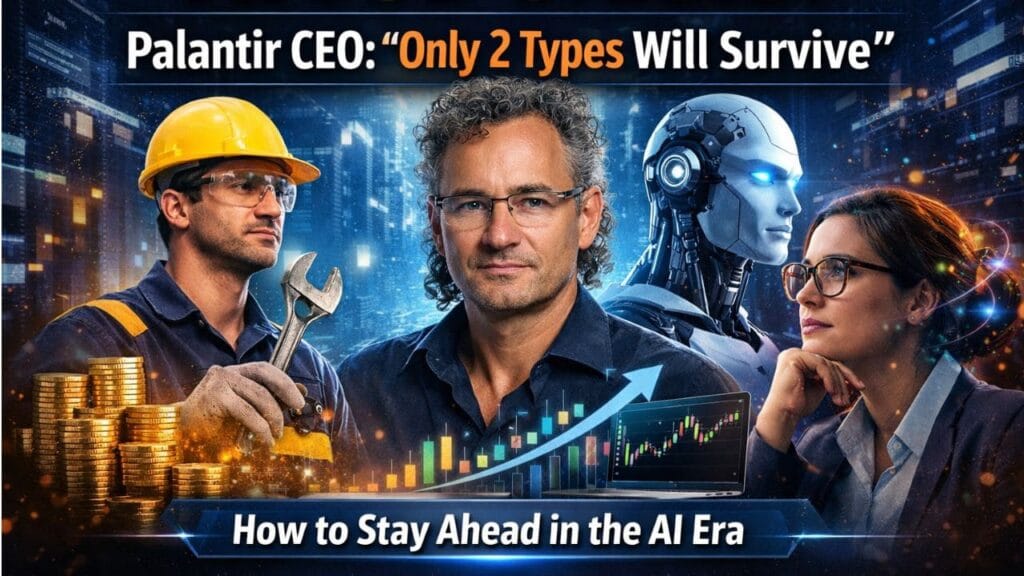
With rapid advancements in AI, many traditional roles are evolving — and some are disappearing altogether. While it’s still unclear who the long-term winners will be, Alex Karp, CEO of Palantir Technologies, believes only certain groups are best positioned to succeed.
According to him, there are two clear paths to staying relevant in the AI era — but there’s also a third path that many people overlook.
1. Hands-On Skills: Why Trade Jobs Are Harder for AI to Replace
One of the most reliable ways to stay secure in the age of AI is by developing practical, hands-on skills.
Table of Contents
Jobs that depend on:
- Physical work
- Real-world environments
- Manual precision
…are far more difficult for AI systems to fully automate.
Roles such as electricians, plumbers, and carpenters continue to remain in demand because they require human presence and adaptability — something machines still struggle with.
Even Geoffrey Hinton, often called the “Godfather of AI,” has pointed out that careers in skilled trades may offer more stability than many office-based jobs. AI is highly effective at handling repetitive digital tasks, but less capable when it comes to unpredictable physical work.
👉 This is why searches like “AI-proof careers” and “jobs safe from automation” are rapidly increasing.
2. Creative Thinkers: The Advantage of Non-Linear Minds
The second group highlighted by Karp includes individuals with non-traditional thinking patterns, often described as neurodivergent.
This includes people with:
- ADHD
- Dyslexia
- Autism
🎁 Free Download: AI Survival Toolkit (2026 Edition)
Want to stay ahead in the AI era?
Get our FREE “AI Survival Toolkit: Skills You Need in 2026” and discover the exact skills, tools, and strategies to future-proof your career.
📩 Need help? Contact us at support@easylearnguide.com
Karp, who has spoken about his own experience with dyslexia, emphasizes that these individuals often bring unique perspectives and creative problem-solving abilities.
Unlike AI, which relies on patterns and data, humans in this category tend to:
- Think outside conventional frameworks
- Generate original ideas
- Adapt quickly to new challenges
As AI takes over routine tasks, these creative and flexible thinking skills are becoming increasingly valuable in the modern workforce.
3. The Hidden Opportunity: Building Wealth Through Investing
But what if you don’t relate to either of these paths?
Not everyone wants to pursue a trade, and not everyone identifies as a creative outlier. Fortunately, there’s another powerful option: investing.
Instead of competing directly with AI, you can take advantage of the economic growth it creates.
🎁 Free Download: AI Survival Toolkit (2026 Edition)
Want to stay ahead in the AI era?
Get our FREE “AI Survival Toolkit: Skills You Need in 2026” and discover the exact skills, tools, and strategies to future-proof your career.
📩 Need help? Contact us at support@easylearnguide.com
Why investing is a smart move:
- Financial markets are more accessible than ever
- Beginner-friendly tools make it easy to start
- You can grow wealth without specialized technical skills
Apps like Robinhood have simplified investing by allowing users to:
- Buy stocks and ETFs
- Invest in fractional shares
- Automate their investments over time
This means you can gradually build a portfolio and benefit from long-term market growth — even with limited experience.
Adapting to the AI Future
The rise of AI doesn’t mean opportunity is disappearing — it means the landscape is changing.
While Alex Karp highlights two strong survival strategies, the bigger picture is clear:
- Learn skills that machines struggle to replicate
- Strengthen your ability to think creatively
- Or position yourself financially through smart investments
As legendary investor Warren Buffett once said, “You don’t need to be a genius to succeed in investing.”
In a world where AI is becoming increasingly powerful, that idea is more relevant than ever.
Final Thoughts: How to Stay Ahead in the AI Era
AI is not just a threat — it’s also an opportunity.
To stay competitive in 2026 and beyond:
- Focus on adaptability
- Build real-world or creative skills
- Explore new income streams like investing
The future won’t be defined by AI alone — it will be shaped by how you choose to respond to it.
👉 The real question is: are you ready to evolve with it?
🔔 Connect With Us
Stay updated with the latest Update,
👉 Join us on WhatsApp – Link
👉 Join our Telegram Channel – Link
👉 Follow us on X (Twitter) – Link
👉 Follow us on Instagram – Link
👉 Like our Facebook Page – Link
👉 Follow us on Threads – Link
🎁 Free Download: AI Survival Toolkit (2026 Edition)
Want to stay ahead in the AI era?
Get our FREE “AI Survival Toolkit: Skills You Need in 2026” and discover the exact skills, tools, and strategies to future-proof your career.
📩 Need help? Contact us at support@easylearnguide.com
📩 Contact & Business Inquiries
Have questions, collaborations, or business opportunities?
Feel free to reach out: contact@easylearnguide.com
Frequently Asked Questions (FAQS)
1. Will AI replace jobs in the United States by 2030?
AI is expected to automate certain tasks, but not entire jobs. In the U.S., many roles will evolve rather than disappear. Jobs that involve creativity, human interaction, and hands-on work are less likely to be fully replaced, while new AI-related careers will continue to emerge.
2. What jobs are safe from AI in 2026?
Jobs that require physical work, human judgment, and adaptability are considered safer from AI. Examples include skilled trades (like electricians and plumbers), healthcare roles, and creative professions. These jobs are harder to automate compared to routine office tasks.
3. What skills should Americans learn to stay relevant in the AI era?
To stay competitive, Americans should focus on skills like digital literacy, critical thinking, communication, and adaptability. Learning how to use AI tools, analyze data, and solve complex problems will also be highly valuable in the future job market.
4. Can AI create more jobs in the U.S. economy?
Yes, AI is expected to create new job opportunities in fields like technology, data analysis, cybersecurity, and AI management. While some roles may decline, the overall impact is likely to include job transformation and the creation of new industries.
5. How can I protect my career from AI disruption?
You can protect your career by continuously learning new skills, adapting to technological changes, and using AI as a tool rather than competing against it. Building multiple income streams, such as freelancing or investing, can also provide additional security.
You May Also Like –
Claude AI for Beginners: Step-by-Step Setup and Usage Guide
I Use AI Every Day: 7 Essential Rules to Avoid Costly Mistakes
Microsoft Launches 3 New AI Models to Compete with OpenAI and Google
AI Breaches One of the World’s Most Secure Operating Systems: Cybersecurity Risks Explained
Artificial Intelligence Faces a Control Crisis: What the AI Industry Doesn’t Want You to Ignore