
Discover the 40 jobs most at risk from AI in 2026, according to Microsoft. See which careers are most exposed, why it matters, and how to stay ahead in the AI era.
Artificial intelligence is rapidly transforming the job market, and a new study from Microsoft sheds light on which careers are most likely to be impacted.
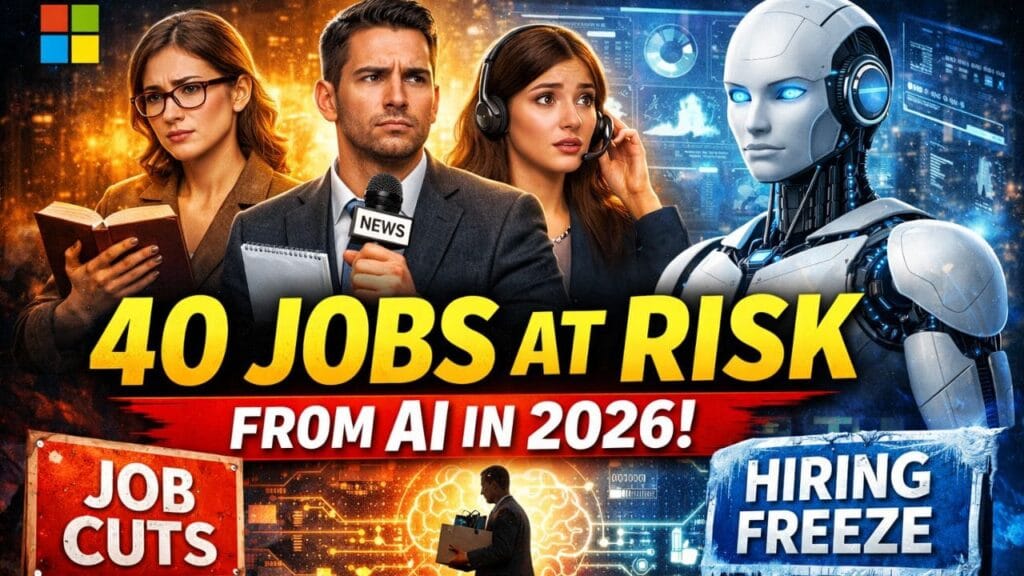
The report identifies 40 occupations with the highest exposure to AI, sparking widespread discussion among professionals. While this doesn’t mean these roles will disappear overnight, it does suggest they are more vulnerable to automation and major changes in the near future.
What the Research Found
Microsoft researchers analyzed thousands of real-world interactions with AI tools like Microsoft Copilot to understand how closely different jobs align with AI capabilities.
Table of Contents
Their conclusion is clear:
Jobs that rely heavily on writing, communication, research, and data processing are the most exposed.
Some of the top roles include:
- Translators and interpreters
- Historians
- Writers and authors
- Customer service representatives
- Sales professionals
These jobs involve tasks that AI can already perform efficiently, such as generating content, answering questions, and analyzing information.
Why Companies Are Shifting Toward AI
Large corporations like Amazon, Meta, and Microsoft are investing billions into AI development.
At the same time, many are:
- Slowing down hiring
- Reducing workforce size
- Automating repetitive tasks
This shift is driven by one goal: higher productivity with lower costs.
As a result, many workers are beginning to question the long-term stability of their careers.
Does High AI Exposure Mean Job Loss?
Not necessarily.
Microsoft researchers emphasize that AI is more likely to assist and transform jobs rather than completely replace them.
Still, industry leaders warn that adaptation is critical. Jensen Huang summed it up well:
The biggest risk isn’t AI itself—it’s being replaced by someone who knows how to use it.
This means professionals who learn to work alongside AI will have a significant advantage.
Worried about AI replacing your job? Discover the 10 powerful skills AI can’t replace and learn how to stay ahead in the future job market.
✔ Future-proof your career
✔ Learn in-demand AI skills
✔ Boost your income potential
📥 Download Free Guide
100% Free • No Spam • Instant Access
Or email us at support@easylearnguide.com to get your copy.
Surprising Insight: Degrees Offer Less Protection
One of the most unexpected findings is that jobs requiring higher education are often more exposed to AI.
Careers like:
- Journalists
- Political scientists
- Management analysts
are all at risk despite requiring a college degree.
This challenges the traditional belief that education alone guarantees job security.
Jobs Least Likely to Be Affected by AI
While office-based roles are changing rapidly, many hands-on jobs remain relatively safe.
Examples include:
- Dredge operators
- Bridge and lock tenders
- Water treatment plant operators
- Construction equipment operators
These roles require physical work and on-site presence, which current AI systems cannot easily replicate.
Top Jobs Most Exposed to AI
Here are some of the most affected occupations identified in the report:
- Interpreters and translators
- Writers and authors
- Customer service representatives
- Sales representatives
- Technical writers
- Journalists and editors
- Data scientists
- Market research analysts
- Web developers
- Public relations specialists
- Management analysts
- Archivists
- Economists and educators
These roles involve tasks that overlap strongly with AI capabilities like content creation, analysis, and communication.
Growth Areas with Lower AI Risk
Not all industries are under threat. Some sectors are actually expanding due to increasing demand.
Healthcare, in particular, continues to grow because it relies heavily on human care and interaction. Roles such as personal care aides and healthcare assistants are expected to see strong job growth over the next decade.
What This Means for Your Career
The rise of AI doesn’t mean the end of jobs—it means a shift in how work is done.
According to Microsoft researcher Kiran Tomlinson, AI is best seen as a tool that enhances productivity, not a full replacement for human workers.
However, the key to staying relevant is clear:
- Learn how to use AI tools
- Build adaptable skills
- Focus on creativity and critical thinking
- Stay updated with industry trends
Final Thoughts
AI is reshaping the global workforce faster than ever before. The careers most at risk are those that rely on tasks AI can already handle—but that doesn’t mean those jobs are disappearing completely.
Instead, the future belongs to those who adapt, evolve, and learn how to work with AI.
Or email us at support@easylearnguide.com to get your copy.
🔔 Connect With Us
Stay updated with the latest Update,
👉 Join us on WhatsApp – Link
👉 Join our Telegram Channel – Link
👉 Follow us on X (Twitter) – Link
👉 Follow us on Instagram – Link
👉 Like our Facebook Page – Link
👉 Follow us on Threads – Link
📩 Contact & Business Inquiries
Have questions, collaborations, or business opportunities?
Feel free to reach out: contact@easylearnguide.com
Frequently Asked Questions (FAQs)
1. Why are there so many layoffs in 2026?
Layoffs in 2026 are mainly driven by rapid AI adoption, cost-cutting measures, and company restructuring. Businesses are automating repetitive tasks and reducing workforce size to improve efficiency, especially in tech and corporate sectors.
2. Are tech layoffs increasing because of AI?
Yes, AI is a major reason behind rising tech layoffs. Companies are using AI to handle tasks like coding, customer service, and data analysis, which reduces the need for certain roles while increasing demand for AI-skilled workers.
3. Which companies are laying off employees in 2026?
Several major companies, including Amazon, Meta, Oracle, Goldman Sachs, and FedEx, have announced layoffs in 2026 across different industries.
4. Will layoffs continue in 2026 and beyond?
Yes, layoffs are expected to continue as AI adoption grows. Companies are still restructuring and investing in automation, which may reduce traditional roles while creating new opportunities in AI-related fields.
5. Which jobs are most affected by layoffs in 2026?
Jobs most affected include customer service, sales, administrative roles, and some tech positions. These roles involve repetitive or data-driven tasks, making them easier to automate using AI tools.
You May Also Like –
AI Job Crisis 2026: Meta Cuts 20,000 Jobs as Microsoft Warns of Massive Workforce Shift
Top 10 Smartest AI Models of 2026 (Ranked & Reviewed)
How to Use Google Chrome’s New AI-Powered Skills (Step-by-Step Guide)
AI Could Impact Over 50% of U.S. Jobs, New Analysis Reveals
Meta Launches First AI Model from Its High-Cost Superintelligence Team