
Discover how Big Tech influenced Trump’s AI executive order reversal, why AI regulation was delayed, and what it means for America’s AI future and competition with China.
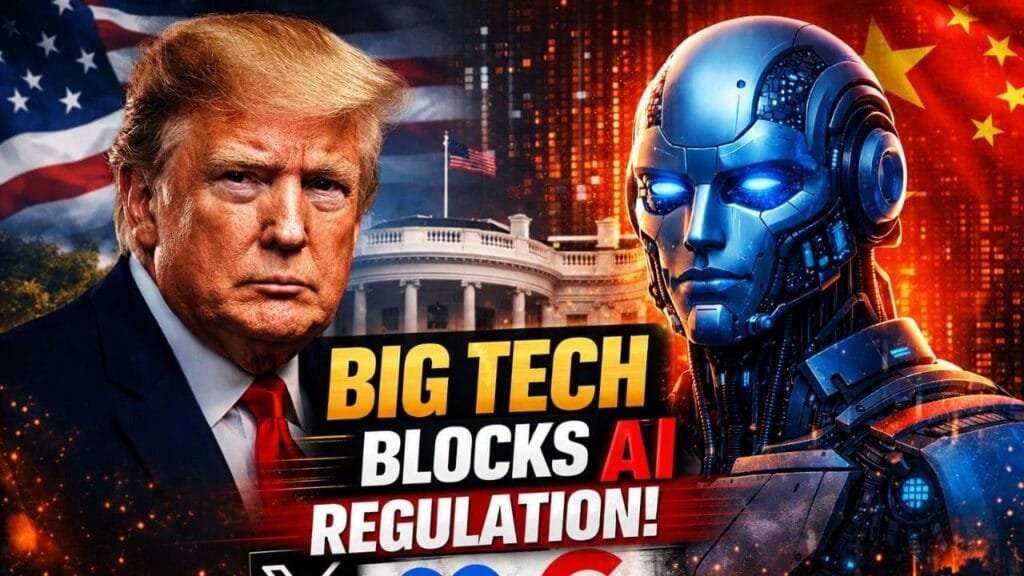
President Donald Trump stepped away from a proposed artificial intelligence executive order that would have introduced voluntary government reviews for advanced AI systems before launch. The decision came only hours before the policy was expected to be signed, highlighting the growing influence of major technology companies over US AI policy.
Trump explained that he did not want new rules to slow America’s position in the global AI race, especially as competition with China continues to intensify.
Speaking at the White House, Trump said the United States currently leads the world in artificial intelligence and that excessive oversight could damage that advantage. His comments reflected the administration’s broader strategy of encouraging rapid AI development with limited federal restrictions.
Silicon Valley’s Role in the Decision
Reports suggest several influential tech leaders privately contacted Trump and members of his administration to oppose the proposal. Industry figures reportedly argued that additional oversight could hurt innovation, weaken the economy, and reduce America’s competitive edge in artificial intelligence.
Table of Contents
The pushback reportedly came from some of the biggest names in technology and venture capital, many of whom have invested heavily in AI products and infrastructure over the past few years.
Their efforts appear to have worked. The administration ultimately delayed the executive order, a move many analysts viewed as a significant victory for the tech industry.
Why the White House Considered AI Oversight
Discussions around stronger AI safeguards reportedly began after concerns emerged over increasingly powerful AI models capable of identifying cybersecurity weaknesses and vulnerabilities in digital systems.
One recently developed AI system reportedly alarmed governments and security experts because of its potential ability to exploit software flaws and target critical infrastructure. Those concerns pushed officials in Washington to explore whether some form of review process was necessary before highly advanced AI systems became publicly available.
🎁 Free AI Regulation Cheat Sheet 2026
Learn how new AI laws, federal regulations, cybersecurity risks, and Big Tech policies are shaping the future of artificial intelligence.
Need help? support@easylearnguide.com
The proposed order was not expected to create strict regulations or mandatory licensing. Instead, it focused on voluntary reviews designed to identify possible national security risks tied to frontier AI technology.
Even with its limited scope, however, many technology companies remained uncomfortable with the proposal.
Trump Maintains a Pro-Tech AI Strategy
Trump has repeatedly positioned himself as supportive of Silicon Valley’s push to expand artificial intelligence development in the United States. His administration has argued that heavy regulation could slow innovation and allow China to gain ground in the AI race.
Over the past year, the White House has built stronger relationships with several leading AI executives and investors. The administration has also taken steps aimed at preventing individual states from introducing separate AI regulations that could create different rules across the country.
Supporters of Trump’s approach believe fewer restrictions will help the US remain the global leader in artificial intelligence, attract investment, and accelerate economic growth.
Critics, however, warn that unchecked AI development could create serious long-term risks.
Growing Concerns About AI Risks
Experts continue to raise concerns about the potential dangers linked to advanced AI systems. Some of the biggest fears include cyberattacks, misinformation campaigns, deepfake content, privacy violations, autonomous weapons, and large-scale job disruption.
Researchers have also warned that powerful AI tools could eventually be used in ways that threaten financial systems, communication networks, and public infrastructure.
Despite these concerns, efforts to introduce meaningful AI regulation in Washington have struggled to gain momentum. Many lawmakers remain divided on how aggressively the technology should be controlled.
The Future of AI Regulation in America
Trump’s decision to delay the executive order signals that stronger federal oversight of artificial intelligence may still be far away. It also demonstrates how much political and financial influence major technology companies now hold in Washington.
With billions of dollars tied to AI growth, Silicon Valley companies are expected to continue lobbying against policies they believe could limit expansion or reduce profits.
As artificial intelligence becomes increasingly central to the global economy, the debate over innovation versus regulation is likely to intensify. For now, however, America’s largest tech companies appear to have secured another important win in the fight over AI policy.
🔔 Connect With Us
Stay updated with the latest Update,
👉 Join us on WhatsApp – Link
👉 Join our Telegram Channel – Link
👉 Follow us on X (Twitter) – Link
👉 Follow us on Instagram – Link
👉 Like our Facebook Page – Link
👉 Follow us on Threads – Link
📩 Contact & Business Inquiries
Have questions, collaborations, or business opportunities?
Feel free to reach out: contact@easylearnguide.com
Frequently Asked Questions (FAQs)
1. What is Trump’s AI executive order?
Answer: Trump’s AI executive order is a policy initiative designed to guide the development and regulation of artificial intelligence in the United States. The administration has focused on promoting innovation, maintaining America’s AI leadership, and competing with China while limiting regulatory barriers for technology companies.
2. Why did Trump delay the proposed AI safety review order?
Answer: Trump reportedly delayed the proposed AI safety review order because he believed certain provisions could slow innovation and weaken America’s competitive advantage in artificial intelligence. The decision sparked debate over whether AI development should prioritize speed or safety.
3. What is artificial intelligence (AI)?
Answer: Artificial intelligence (AI) is a technology that enables computers and machines to perform tasks that normally require human intelligence. These tasks include learning, reasoning, language processing, problem-solving, and generating content such as text, images, and videos.
4. What is Claude AI?
Answer: Claude AI is an advanced AI chatbot developed by Anthropic. It helps users with writing, coding, research, data analysis, and business tasks. Claude is known for its focus on AI safety, reliability, and producing detailed responses.
5. Why is AI regulation becoming a major issue in the United States?
Answer: AI regulation is becoming a major issue because advanced AI systems can affect cybersecurity, privacy, misinformation, jobs, and national security. Policymakers are trying to balance innovation with safeguards that reduce risks while keeping the United States competitive in the global AI race.
You May Also Like –
Microsoft Study Reveals 40 Jobs at Highest Risk from AI — Full List Including Teachers
What Is Trusted Contact in ChatGPT? OpenAI’s New Security Feature Explained
NASA Launches Prithvi: World’s First AI Geospatial Foundation Model in Space
Meta Platforms to Monitor Employee Screens & Keystrokes for AI Training: Privacy Concerns Explained
How Sundar Pichai Turned Google into an AI Leader: Strategy Behind Winning the AI Race