
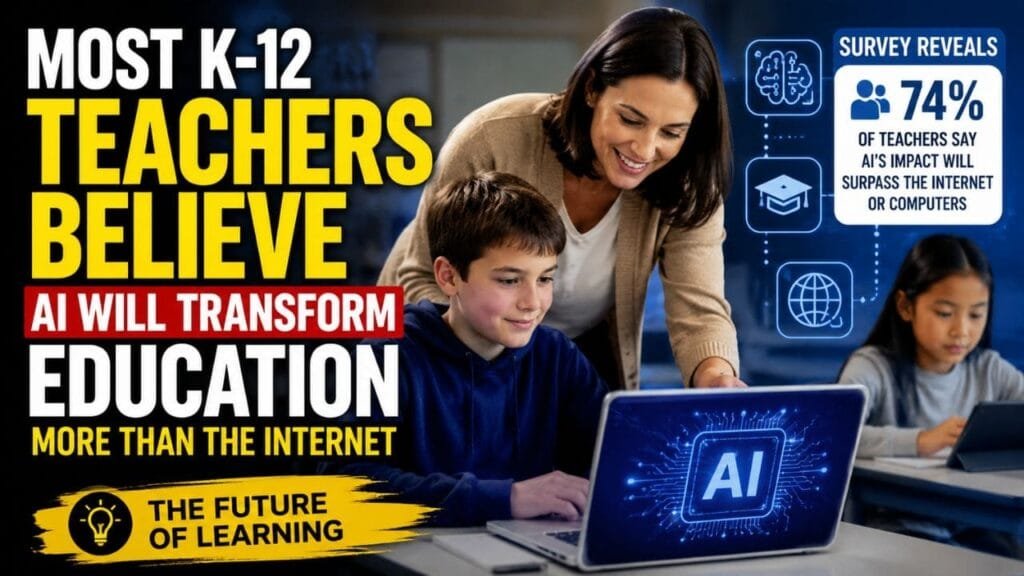
A new survey reveals that most K-12 teachers believe AI will have a greater impact on education than the internet or computers, raising concerns about critical thinking and classroom learning.
Artificial intelligence is becoming one of the most influential technologies in modern education, and many teachers believe its impact could surpass that of the internet and personal computers.
A recent survey conducted by NPR and Ipsos found that a large majority of K-12 educators view AI as a transformative force that will significantly shape the future of teaching and learning. While teachers acknowledge the benefits AI can bring to classrooms, many are also expressing concerns about its effects on student independence, critical thinking, and academic integrity.
Teachers Expect AI to Reshape Classrooms
For decades, schools have adapted to technological advancements ranging from desktop computers to online learning platforms. However, many educators now believe artificial intelligence represents a much bigger shift.
Table of Contents
According to the survey, nearly three-quarters of teachers said AI’s influence on education will likely exceed the impact created by previous technological innovations. This growing sentiment reflects the rapid adoption of AI tools across schools and workplaces.
Many teachers also believe students need formal instruction on how to use AI responsibly. Rather than ignoring the technology, educators increasingly support integrating AI literacy into school curricula.
Educators Are Using AI to Improve Efficiency
While student use of AI remains relatively limited in many classrooms, teachers themselves are increasingly embracing the technology.
Many educators report using AI-powered tools to streamline routine tasks, including lesson planning, worksheet creation, quiz development, and classroom resource preparation. Tasks that once required significant preparation time can often be completed much faster with AI assistance.
For busy teachers balancing instruction, grading, and administrative responsibilities, AI is becoming a valuable productivity tool. Although the amount of time saved varies, many educators say the technology helps reduce workload and improve efficiency.
AI Remains a Tool, Not a Replacement
Despite its advantages, teachers emphasize that AI-generated content still requires human oversight.
Educators have found that AI can occasionally provide incomplete, misleading, or inaccurate information. Because of this, teachers often review and verify AI-generated materials before using them in classrooms.
Many see AI as a helpful assistant rather than a substitute for professional expertise. They believe technology can support teaching, but human judgment remains essential when evaluating information and guiding student learning.
Concerns Grow Over Critical Thinking Skills
One of the most common concerns among educators is the possibility that students may become overly dependent on artificial intelligence.
More than half of surveyed teachers worry that easy access to AI-generated answers could discourage students from developing problem-solving and analytical skills. Instead of working through challenges independently, students may be tempted to rely on technology for quick solutions.
Teachers argue that critical thinking remains one of the most important skills students can develop. As AI becomes more accessible, educators say students must learn how to question, verify, and evaluate information rather than accepting AI-generated responses at face value.
AI Can Create Opportunities for Some Learners
Although concerns exist, teachers also recognize situations where AI can provide meaningful educational support.
Students with disabilities or unique learning needs may benefit from AI-powered assistance that helps them understand instructions, organize ideas, and complete assignments more effectively. In some cases, AI can serve as an additional learning resource that improves accessibility and classroom participation.
Get the latest AI news, technology updates, tutorials, and in-depth analysis delivered directly to your screen.
▶ Subscribe on YouTubeMany educators believe the technology has the potential to support student success when used appropriately and under proper guidance.
Academic Integrity Is Becoming More Challenging
As AI tools become more sophisticated, teachers face increasing difficulties in determining whether assignments reflect students’ own work.
Many educators report adapting their teaching methods by placing greater emphasis on classroom-based activities, handwritten assignments, and direct student participation. These changes help teachers better assess individual understanding and reduce opportunities for misuse.
The rise of AI-generated essays, answers, and images has introduced new challenges that schools are still learning to address.
Schools Are Still Catching Up
Despite the growing presence of AI in education, many teachers say they have received limited guidance from schools and districts.
Survey results indicate that numerous educators lack access to formal AI policies, training programs, or professional development opportunities. As a result, many teachers are independently learning how to incorporate AI into their classrooms while navigating its potential risks.
Education experts suggest that schools will need clearer guidelines, stronger training initiatives, and updated policies to ensure AI is used effectively and responsibly.
Looking Ahead
Artificial intelligence is rapidly becoming a permanent part of the educational landscape. Teachers recognize its ability to save time, increase efficiency, and provide valuable learning support. At the same time, they remain cautious about the technology’s influence on student thinking, academic honesty, and classroom relationships.
As schools continue adapting to AI-driven changes, educators agree on one key point: the focus should not be on whether AI belongs in education, but on how it can be used in ways that strengthen learning while preserving the human skills students need to succeed.
🔔 Connect With Us
Stay updated with the latest Update,
👉 Join us on WhatsApp – Link
👉 Join our Telegram Channel – Link
👉 Follow us on X (Twitter) – Link
👉 Follow us on Instagram – Link
👉 Like our Facebook Page – Link
👉 Follow us on Threads – Link
📩 Contact & Business Inquiries
Have questions, collaborations, or business opportunities?
Feel free to reach out: contact@easylearnguide.com
Frequently Asked Questions (FAQs)
1. Why do many K-12 teachers believe AI will have a bigger impact than the internet?
Many teachers view AI as a transformative technology because it can generate content, personalize learning, automate tasks, and assist both educators and students. Unlike the internet, AI can actively interact with users and support educational activities in real time.
2. How are teachers currently using AI in schools?
Teachers commonly use AI for lesson planning, creating quizzes, generating classroom materials, drafting parent communications, and reducing administrative workloads. Many educators say AI helps them save time and improve classroom efficiency.
3. Does AI improve student learning?
AI can enhance learning by providing personalized support, instant feedback, and additional educational resources. However, teachers emphasize that students should use AI as a learning tool rather than relying on it to complete work without understanding the material.
4. Why are educators concerned about AI and critical thinking?
Many teachers worry that students may become too dependent on AI-generated answers. This could reduce opportunities to develop problem-solving, analytical, and critical-thinking skills that are essential for academic and career success.
5. Should schools teach responsible AI use?
Yes. Most educators believe schools should teach students how to use AI responsibly. This includes understanding AI limitations, fact-checking information, protecting privacy, and using AI ethically in academic settings.
6. Can AI help students with disabilities?
AI can provide valuable support for students with disabilities by offering personalized assistance, simplifying complex information, improving accessibility, and helping students complete assignments more effectively.
7. Will artificial intelligence replace teachers in the future?
Most experts believe AI will support teachers rather than replace them. While AI can automate certain tasks, teachers remain essential for mentoring students, fostering critical thinking, and providing human guidance in the classroom.
You may also like
House Unveils AI Draft Bill That Would Override State AI Laws
Trump Signs AI Executive Order: Key Changes, Impact, and What It Means for America
How Big Tech Shaped Trump’s AI Executive Order Behind the Scenes
Microsoft Study Reveals 40 Jobs at Highest Risk from AI — Full List Including Teachers