
Tesla is capping employee AI spending at $200 per week while exempting Grok and xAI beta tools. Learn why Tesla changed its AI policy and what it means for employees, AI costs, and Elon Musk’s strategy.
Tesla has spent the last year encouraging employees to embrace artificial intelligence. Now, it’s asking them to slow down.
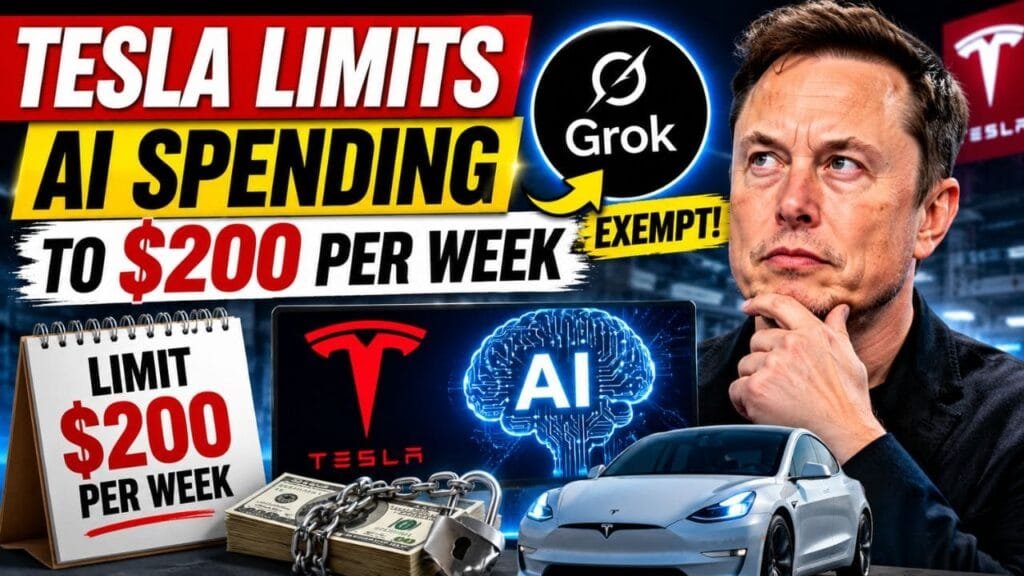
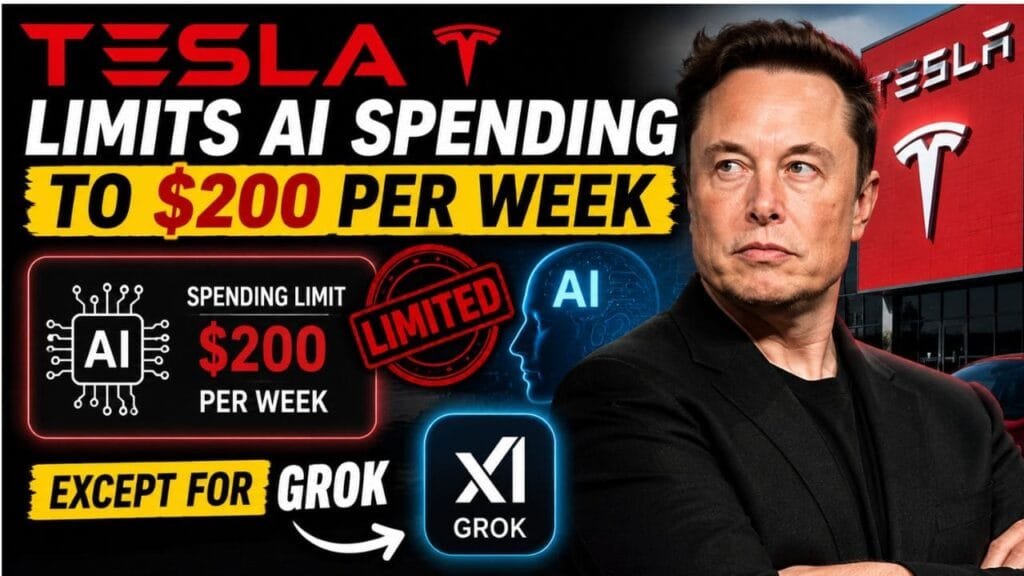
According to an internal memo first reported by The Information, Tesla will introduce a $200 weekly spending limit on AI tools for employees starting July 6. Anyone who wants to spend more than that will need approval from management.
At first glance, the move looks like a simple cost-cutting measure. But there’s one detail that’s drawing attention across the tech industry: the limit doesn’t apply to beta versions of xAI products like Grok.
Table of Contents
That exception says a lot about where Tesla—and Elon Musk—want the company’s AI future to go.
Tesla Went From Encouraging AI to Controlling It
Not long ago, Tesla was pushing employees to use AI as much as possible.
The company introduced approved AI models, rolled out internal security policies, and encouraged teams to make AI part of their everyday workflow. In some departments, managers even created leaderboards that tracked AI token usage, turning adoption into a friendly competition.
Employees responded exactly as expected.
Software engineers began relying on AI for coding, debugging, documentation, and research. Productivity improved—but so did the company’s AI bill.
Reports suggest that some engineers were generating thousands of dollars in AI costs every week, making it clear that unlimited AI access wasn’t financially sustainable.
Instead of discouraging AI altogether, Tesla has decided to put spending guardrails in place.
Grok Gets a Free Pass
The most interesting part of Tesla’s new policy isn’t the spending cap—it’s the exception.
While most third-party AI tools count toward the $200 weekly limit, beta versions of Grok and other xAI products do not.
That effectively gives Tesla employees a financial incentive to use Musk’s own AI platform instead of competitors.
It’s not difficult to understand why.
Elon Musk has invested heavily in building xAI into a serious competitor in the artificial intelligence market. Encouraging Tesla employees to use those products helps improve testing, gather feedback, and strengthen adoption from within.
For Tesla, every internal user becomes another opportunity to refine its own AI ecosystem.
Employees Still Prefer Other AI Tools
Even with Tesla promoting Grok internally, many employees reportedly continue using competing AI assistants whenever possible.
Several reports indicate that developers often prefer Claude for programming and technical work, citing stronger performance and more reliable results.
That’s not unusual.
Most software engineers choose tools based on how well they solve problems—not who owns them. If one AI assistant helps complete tasks faster or produces cleaner code, it naturally becomes the preferred option.
The challenge for Tesla isn’t simply encouraging employees to use Grok. It’s convincing them that it’s the best tool for the job.
Tesla Isn’t the Only Company Watching AI Costs
Tesla’s decision reflects a much larger trend happening across corporate America.
Over the past year, businesses have rushed to integrate generative AI into everyday work. While the productivity gains have been impressive, the costs have also started adding up.
Unlike traditional software subscriptions, many AI services charge based on usage. Every conversation, code generation request, or document analysis consumes tokens—and those tokens quickly become expensive when thousands of employees are involved.
As a result, more companies are introducing AI budgets, usage limits, and approval processes to keep spending under control.
Tesla simply happens to be one of the latest examples.
AI Is Central to Tesla’s Future
This policy matters because artificial intelligence isn’t just another business tool for Tesla—it’s a core part of the company’s long-term vision.
Elon Musk has repeatedly argued that Tesla’s future value will depend more on AI-powered products than on selling electric vehicles alone.
Projects such as the Robotaxi platform, Optimus humanoid robot, and AI-driven manufacturing all rely heavily on advances in artificial intelligence.
Inside the company, Tesla has also introduced Nova, an internal AI assistant trained on company knowledge to help employees answer questions, troubleshoot manufacturing issues, and access technical information more quickly.
The goal isn’t simply to automate tasks—it’s to make engineering and manufacturing smarter.
Security Is Becoming Just as Important as Cost
Managing AI spending is only part of the equation.
Tesla has also tightened its internal AI security policies by limiting access to non-approved AI tools and reminding employees not to upload confidential company information into external systems.
For a company known for protecting its intellectual property, that move makes perfect sense.
As AI becomes more deeply integrated into daily work, balancing innovation with data security is becoming just as important as controlling costs.
The Bigger Picture
Tesla’s new AI policy highlights a reality that many businesses are beginning to face.
Adopting artificial intelligence is easy.
Managing it responsibly is much harder.
Companies want employees to benefit from AI because it improves productivity and speeds up decision-making. But they also need to control expenses, protect sensitive information, and ensure the technology delivers real value.
Tesla’s new spending cap reflects that balancing act.
Final Thoughts
Tesla’s $200 weekly AI spending limit isn’t a sign that the company is backing away from artificial intelligence. If anything, it shows that AI has become important enough to require clear rules and smarter financial oversight.
The exemption for Grok makes the policy even more interesting. By encouraging employees to use xAI products while limiting spending on competing platforms, Tesla is reinforcing its commitment to building an AI ecosystem that extends across Elon Musk’s companies.
Whether employees ultimately embrace Grok or continue favoring other AI assistants remains to be seen. One thing is certain, though: as AI becomes an everyday workplace tool, managing its costs will be just as important as unlocking its potential.
🔔 Connect With Us
Stay updated with the latest Update,
👉 Join us on WhatsApp – Link
👉 Join our Telegram Channel – Link
👉 Follow us on X (Twitter) – Link
👉 Follow us on Instagram – Link
👉 Like our Facebook Page – Link
👉 Follow us on Threads – Link
📩 Contact & Support
Have questions, feedback, support requests, collaborations, or business opportunities?
Feel free to reach out:
📧 Business Inquiries: contact@easylearnguide.com
📧 Support & General Assistance: support@easylearnguide.com
Frequently Asked Questions (FAQs)
1. Why is Tesla limiting employee AI spending to $200 per week?
Tesla introduced the $200 weekly AI spending limit to better manage the rising costs of AI tools across the company. As employees increasingly relied on AI for coding, research, and productivity, usage-based billing caused expenses to grow quickly. The new policy helps Tesla control costs while still encouraging responsible AI adoption.
2. Does Tesla’s AI spending cap apply to Grok?
No. According to the new policy, Tesla’s $200 weekly AI spending limit does not apply to beta versions of Grok and other xAI products. This exemption allows employees to continue using Grok without those costs counting toward their weekly AI budget, encouraging greater adoption of Tesla’s preferred AI ecosystem.
3. Why is Tesla promoting Grok instead of other AI tools?
Tesla is promoting Grok, developed by xAI, because it aligns with Elon Musk’s broader AI strategy. By encouraging employees to use in-house AI tools, Tesla can gather valuable feedback, improve product development, reduce reliance on third-party platforms, and strengthen its own AI ecosystem.
4. How does Tesla use artificial intelligence inside the company?
Tesla uses AI across multiple areas of its business, including software development, engineering, manufacturing, quality control, and internal knowledge management. The company has also introduced AI assistants to help employees solve technical problems, access company information, and improve workplace efficiency.
5. What does Tesla’s new AI policy mean for the future of workplace AI?
Tesla’s policy reflects a growing trend among large companies to balance AI innovation with cost management. As businesses adopt AI at scale, many are introducing spending limits, security policies, and approved AI platforms to maximize productivity while keeping operational expenses under control. This approach could become a model for other organizations adopting enterprise AI.
You may also like
AI Boom Faces a New Threat: How Severe Weather Is Disrupting Data Centers and Technology
Can AI Answer Life’s Biggest Questions? Why Not Knowing May Lead to the Truth
U.S. Approves Iranian Oil Sales as Final Peace Deal Negotiations Advance
5 AI Predictions for 2030 That Could Change the Future Forever
Jeff Bezos Says AI Will Create a Labor Shortage, Not Replace Human Workers
Tech Workers Are Cutting Back on AI After Reaching Peak Usage: Here’s Why
Jeff Bezos-Backed Prometheus Raises $12 Billion to Build an Artificial General Engineer