
Discover why AI model routers are becoming essential for businesses in 2026, helping companies reduce AI inference costs, improve performance, and choose the right AI model for every task.
Nobody likes opening a bill and realizing it is far higher than expected. Yet that is becoming a real problem for companies that are putting AI agents to work.
AI coding agents such as Claude Code and Codex can now handle tasks that once required developers to sit in front of a computer for hours. They can inspect code, write new files, fix errors, run commands, and keep working with surprisingly little human involvement.
There is just one catch: all that AI work costs money.
Table of Contents
An agent may continue calling an AI model again and again while a developer is away from their desk. If the task is complicated or runs for several hours, the number of tokens consumed can climb quickly.
That is one reason AI model routers are suddenly attracting so much attention from businesses.
Instead of sending every request to the most expensive and powerful AI model, a model router can decide which model makes the most sense for a particular task. The goal is simple: get the required result without spending more than necessary.
For companies running AI at scale, that can make a noticeable difference.
What Is an AI Model Router?
Think of an AI model router as a traffic controller for artificial intelligence.
A business might use several AI models from different providers. One model may be excellent at coding, another may be faster for simple requests, and another may offer stronger reasoning but cost considerably more.
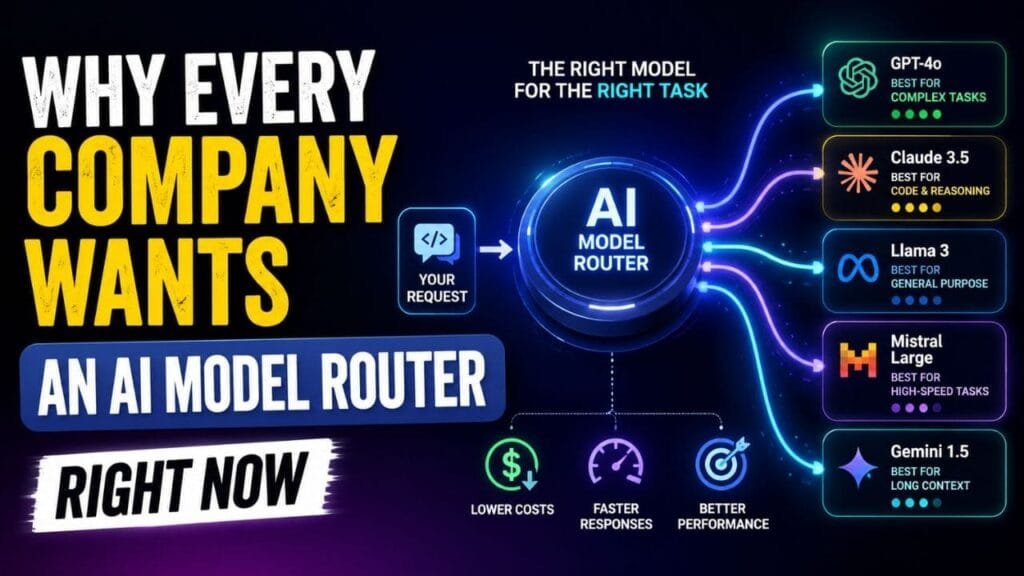
Rather than forcing every request through the same model, routing software can evaluate the task and send it to an appropriate model.
For instance, a company could use:
- A cheaper model for straightforward classification.
- A fast model for simple customer-service requests.
- A stronger reasoning model for complicated coding problems.
- A frontier model for particularly difficult research or analysis.
The idea isn’t to always use the cheapest AI.
It is to use the right AI for the job.
That distinction is becoming increasingly important as companies move from experimenting with AI to using it in everyday operations.
AI Coding Agents Are Making the Problem Bigger
The growing popularity of AI coding agents is one of the biggest reasons model routing has become important.
A normal chatbot interaction might involve a handful of prompts and responses. An autonomous coding agent works differently.
It can take a goal, break it into smaller steps, inspect a codebase, call tools, write code, test the result, find an error, and try again.
Each of those steps can involve another AI model request.
Now imagine thousands of developers across a large company using these agents every day.
The amount of AI inference can grow surprisingly quickly.
A developer might start an agent before going to lunch and expect it to finish a task independently. By the time they return, the agent may have made dozens or even hundreds of model calls.
The result can be a much larger AI bill than the company originally expected.
Why AI Inference Costs Are Becoming a Business Problem
AI costs were relatively easy to overlook when companies were running small experiments.
That is changing.
As organizations put AI into production, inference becomes an ongoing operating expense. The more employees, customers, and AI agents use these systems, the more important cost management becomes.
A study cited in recent reporting found that 62% of organizations said an unexpected AI expense materially affected a business decision during the previous year.
Some organizations responded by escalating the problem to senior leadership, freezing spending, or delaying AI projects.
The exact numbers will vary from company to company, but the underlying issue is straightforward:
AI is becoming a real business expense, not just an experimental technology.
That is creating demand for tools that can make AI spending more predictable.
Why Companies Don’t Need the Most Powerful AI Model Every Time
There is a common assumption in the AI industry that the newest and smartest model should handle everything.
That sounds logical.
But it is not always economical.
Imagine asking a highly capable reasoning model to perform a task that a much smaller model can complete just as accurately. The company would be paying a premium without necessarily receiving a better result.
This is where model routing becomes useful.
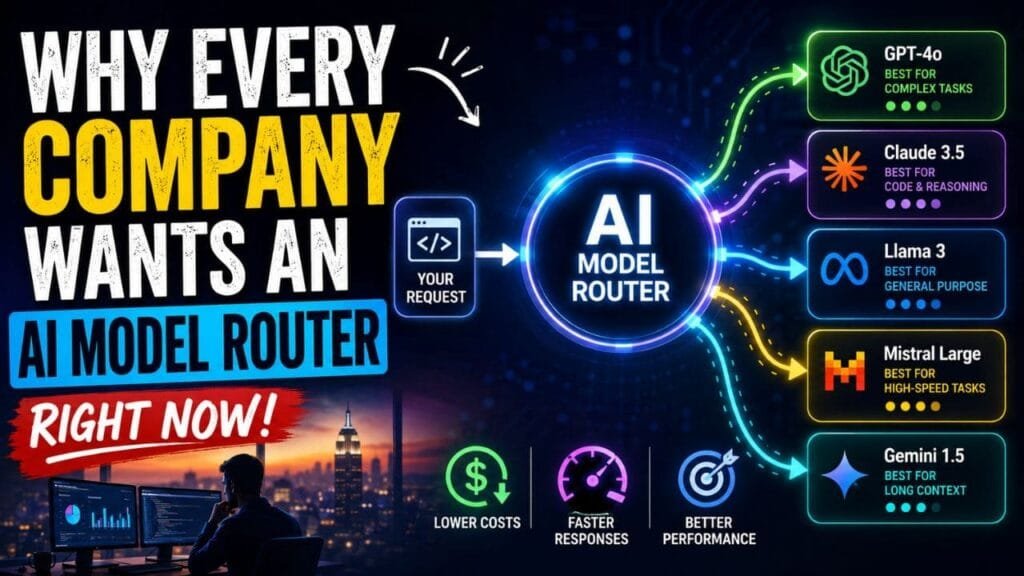
A router can look at the task and determine whether it actually needs a powerful model.
Some tasks are already “intelligence-saturated.” In other words, making the model smarter does not necessarily make the outcome better.
A simple data classification task is a good example. If a cheaper model already produces the correct answer consistently, there may be little reason to use an expensive frontier model.
At the same time, going too cheap can backfire.
A smaller model may struggle with a difficult problem and require several attempts. The company might save money on each individual request but spend more overall because the task takes longer to complete.
That is why good AI model routing is about more than simply finding the lowest price.
It is about balancing cost, quality, speed, and reliability.
AI Model Routing Is Turning Into a Competitive Market
The potential savings have attracted a growing number of companies to the AI routing market.
Different businesses are taking different approaches.
OpenRouter, for example, provides a unified gateway through which developers can access numerous AI models. This can make it easier to work with multiple model providers without building a separate integration for every one.
Not Diamond takes a more automated approach, attempting to determine which model is best suited to a particular request.
LiteLLM provides infrastructure that organizations can use to connect applications with different AI models and build their own routing systems.
Large enterprise technology companies are also adding routing capabilities to their AI platforms.
The growing competition suggests that model routing could become a standard part of the AI infrastructure stack.
Model Routers Could Become More Than Cost-Cutting Tools
Saving money may be the most obvious reason companies are adopting AI routers, but it probably won’t be the only one for long.
Large organizations have other concerns when deploying AI.
They need to think about:
- Security
- Privacy
- Compliance
- Reliability
- Latency
- Governance
- Data access
- Model availability
- Vendor risk
- Business performance
For example, a company may not want sensitive customer information sent to every available AI model.
A routing system could eventually take those rules into account before deciding where a request should go.
That means the future of AI routing may be less about simply choosing a model and more about controlling the entire AI workflow.
The question could shift from:
“Which model should answer this request?”
to:
“Which model, tool, and data source should handle this request under our company’s rules?”
Model Routers Can Give Companies More Flexibility
There is another reason businesses are interested in AI routing: they don’t want to become completely dependent on one AI provider.
The AI market changes extremely quickly.
A provider can change its pricing, modify an API, restrict access, experience an outage, or release a new model that changes the competitive landscape.
For a company relying on AI for a critical business process, that creates a risk.
A routing layer can provide another option.
Instead of building an application around a single model, a business can potentially connect multiple providers and switch between them when circumstances change.
If one model becomes unavailable, another could take over.
If a cheaper model becomes good enough for a particular task, the company can route that workload there.
That flexibility could become just as valuable as cost savings.
Building a Good AI Router Isn’t Easy
On paper, AI routing sounds simple.
You connect several models, look at the request, and choose one.
In the real world, it is considerably harder.
A production-ready routing system may need to constantly monitor model providers, pricing, latency, reliability, performance, and availability.
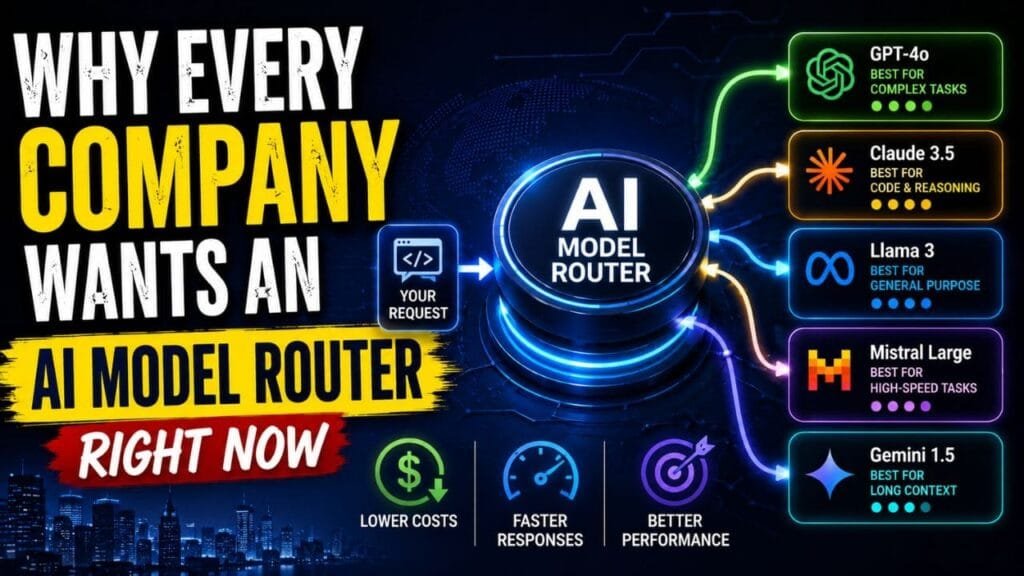
AI models also change frequently.
A model that performs extremely well today might be replaced by a better option next month. Pricing can change. APIs can change. Providers can experience outages.
A router therefore needs to keep learning about the models it is managing.
It may also need to consider the quality of the answers it receives rather than simply looking at price and speed.
That makes AI model routing a much deeper infrastructure problem than a simple API switch.
The Future of AI Model Routing
The growth of AI agents could make model routing even more important over the next few years.
As businesses deploy agents that can work independently for longer periods, the number of AI requests generated by a single workflow can increase dramatically.
That creates an interesting challenge.
Companies want AI systems that are increasingly capable, but they also need those systems to remain affordable.
Model routers could help solve part of that problem by making AI systems more selective about which model they use and when.
Instead of automatically choosing the most powerful model, an AI application could dynamically select the model that makes the most sense for each step.
Over time, routing could also become an important layer for AI governance, security, compliance, and vendor management.
Final Thoughts
The rise of AI model routers is closely connected to the way businesses are starting to use AI.
When AI was mostly about answering questions, choosing a model was relatively simple. But autonomous agents are changing the equation.
An agent can make dozens or hundreds of decisions and model calls while working on a single task. At enterprise scale, those calls can turn into a substantial expense.
That is why companies are looking beyond simply finding the “best” AI model.
They want the best model for the specific job.
Sometimes that will be the most powerful model available. Other times, a cheaper and faster model will do the job just as well.
The companies that figure out how to make those decisions automatically could have an important advantage as AI becomes a much bigger part of everyday business.
The future of enterprise AI may not be about using one perfect model.
It may be about having the intelligence to choose the right model at the right time.
🔔 Connect With Us
Stay updated with the latest Update,
👉 Join us on WhatsApp – Link
👉 Join our Telegram Channel – Link
👉 Follow us on X (Twitter) – Link
👉 Follow us on Instagram – Link
👉 Like our Facebook Page – Link
👉 Follow us on Threads – Link
📩 Contact & Support
Have questions, feedback, support requests, collaborations, or business opportunities?
Feel free to reach out:
📧 Business Inquiries: contact@easylearnguide.com
📧 Support & General Assistance: support@easylearnguide.com
Frequently Asked Questions (FAQs)
1. What is an AI model router?
An AI model router is software that automatically selects the most suitable AI model for a specific task based on factors such as cost, speed, performance, and complexity.
2. How does AI model routing work?
AI model routing analyzes a request and sends it to the AI model best suited to handle it. The system can consider task complexity, model performance, pricing, response speed, and availability.
3. Can an AI model router reduce AI costs?
Yes. AI model routers can reduce costs by sending simple tasks to cheaper models while reserving expensive, powerful models for complex requests.
4. Why do businesses need AI model routing?
Businesses use AI model routing to control AI expenses, improve performance, reduce reliance on a single provider, and choose the right model for different workloads.
5. What are the best AI model routers for businesses?
Popular AI model routing options include OpenRouter and LiteLLM. The best choice depends on a company’s budget, privacy requirements, infrastructure, model selection, and routing needs.
You may also like –
Can the U.S. Win Asia’s AI Market as China Dominates Cheaper Models?
What Is Model Context Protocol (MCP)? How It Connects AI Models to Tools and Data
Tesla Limits Employee AI Spending to $200 Per Week, Except for Grok
AI Boom Faces a New Threat: How Severe Weather Is Disrupting Data Centers and Technology
Can AI Answer Life’s Biggest Questions? Why Not Knowing May Lead to the Truth
U.S. Approves Iranian Oil Sales as Final Peace Deal Negotiations Advance
5 AI Predictions for 2030 That Could Change the Future Forever