
Can the U.S. win Asia’s AI market as China expands with cheaper, open AI models? Explore the U.S.-China AI race, technology exports, and Asia’s future.
The global AI race is no longer limited to Silicon Valley, Beijing, or the companies building the world’s most powerful models. A major part of the competition is now playing out across Asia.
For the United States, the goal is clear: encourage Asian governments and businesses to build their AI future around American technology. China is pursuing the same opportunity, but with a different advantage—AI models that are often cheaper, more open, and easier for organizations to customize.
This creates an important question: Can the U.S. maintain its AI influence in Asia when Chinese companies are offering lower-cost alternatives?
Table of Contents
The U.S. Offers a Complete AI Ecosystem
The United States remains a leader across many parts of the AI industry. American companies develop advanced AI chips, cloud platforms, large language models, software tools, and enterprise applications.
That gives the U.S. an advantage that goes beyond a single AI model.
A government or company can potentially use American technology throughout the entire AI process—from the hardware used to train models to the cloud services and software needed to deploy them.
Gary Dvorchak, managing director at The Blueshirt Group, described the broader U.S. strategy as an effort to prevent China from becoming the main AI supplier for Asia and eventually other parts of the world.
However, a complete AI ecosystem does not always mean the lowest price.
Chinese AI companies have gained attention by offering capable models at lower costs. For countries with limited technology budgets, affordability can be just as important as having access to the most advanced system.
Asia Is Becoming a Major AI Battleground
Asia is home to fast-growing digital economies, large populations, expanding technology industries, and governments that are investing heavily in artificial intelligence.
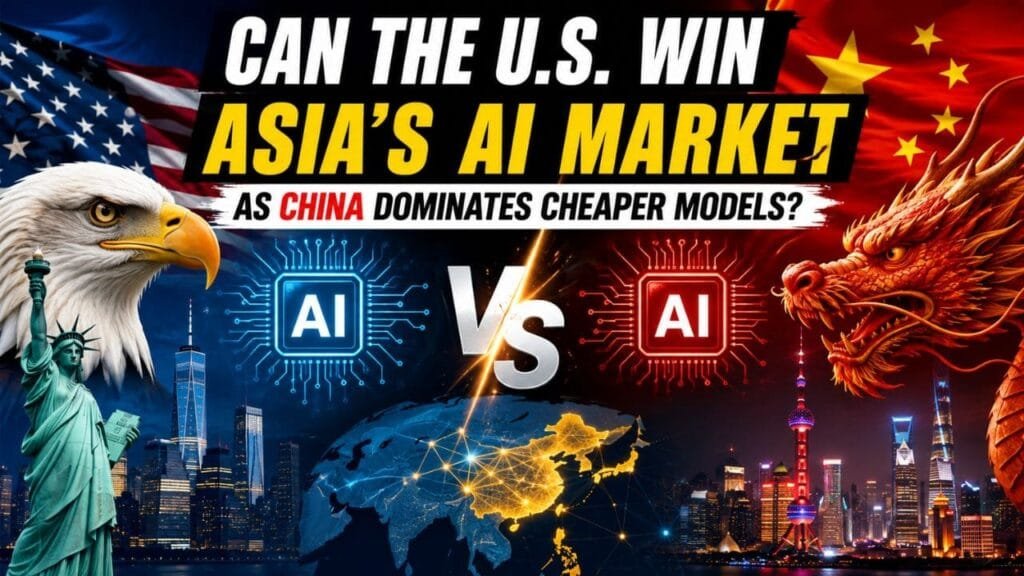
Countries across the region are looking for AI tools that can improve public services, support businesses, strengthen education, increase productivity, and accelerate scientific research.
This demand has created a major opportunity for both the United States and China.
The competition was visible during APEC Digital Weeks in Chengdu, China. Although U.S. representatives had previously highlighted AI as an important part of the event, America’s public presence appeared relatively limited.
Chinese companies and officials, meanwhile, used the gathering to promote their AI technology and strengthen relationships across the Asia-Pacific region.
The contrast raised questions about how effectively the U.S. is presenting its AI strategy in one of the world’s most important technology markets.
The U.S. Is Promoting AI Exports
The American government has introduced initiatives designed to make U.S. AI technology more accessible to international partners.
One of the most important efforts is the American AI Exports Program, which aims to connect foreign governments and organizations with American AI products and services.
The program is designed to provide flexibility. Countries may choose a complete U.S. technology system or adopt only the tools they need, such as AI models, cloud services, software, or other technology.
At an APEC AI forum in Chengdu, Bill Guidera of the U.S. Department of Commerce emphasized the importance of cooperation across the Asia-Pacific region.
He highlighted the security, capability, and design of American AI technology.
However, questions have emerged about the program’s early level of participation. Reports suggested that the number of applications was lower than expected, while the Commerce Department said interest had exceeded expectations.
The difference in these accounts makes it difficult to judge the program’s early performance. Its long-term success will likely depend on whether U.S. companies can offer affordable, practical, and reliable AI solutions to international customers.
U.S. Technology Companies Took a Different Approach
American business participation at the Chengdu event also appeared limited.
Google and Meta were among the most visible U.S. companies present. However, neither focused heavily on promoting large language models.
Google highlighted AlphaFold, an AI system that supports scientific research by helping researchers study protein structures. Meta focused on AI tools that could help small businesses improve efficiency and reach customers.
Google executive Wilson L. White made only brief references to Gemini during his presentation.
Chinese companies used the event differently. Tencent promoted the growing adoption of its Hunyuan large language model and discussed AI-related cloud projects in Thailand.
The contrast showed that the competition is not only about who has the most powerful AI model. It is also about how companies explain the value of their technology to governments, businesses, and the public.
China Is Using AI to Build Stronger Regional Partnerships
China is hosting APEC during a period of rising technology competition with the United States.
Beijing has used the opportunity to present itself as a long-term AI partner for countries across Asia and other developing regions.
A major part of China’s strategy is its support for open-source and open-weight AI models.
Many leading U.S. AI companies keep their most advanced systems closed. Access may require paid subscriptions, cloud services, or approval from the company.
Open AI models can give governments and businesses more freedom. They may be able to adapt the technology, run it on their own infrastructure, and develop local applications without relying entirely on a foreign provider.
For countries that want greater control over their technology, this approach can be attractive.
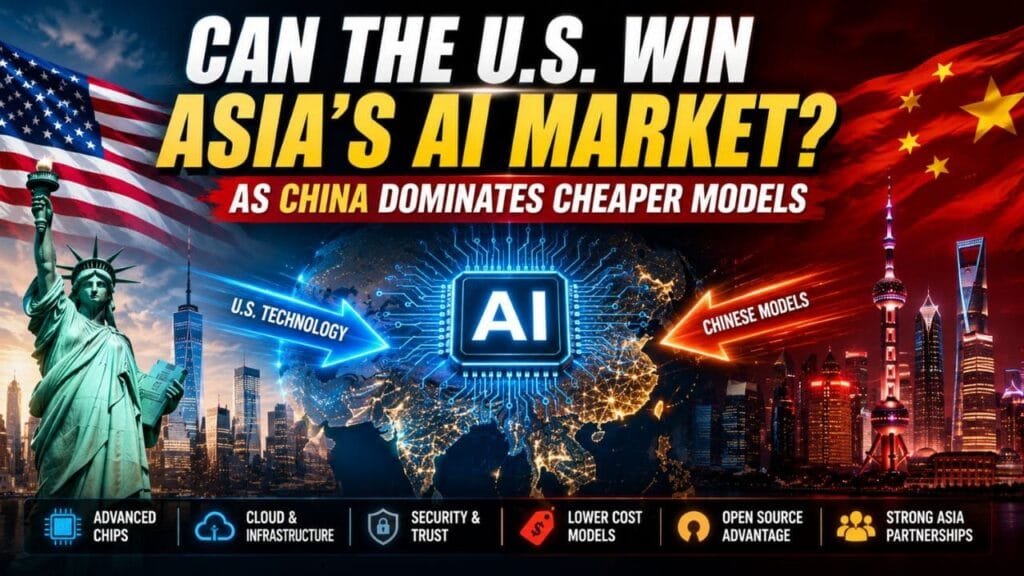
At the World AI Conference in Shanghai, Chinese President Xi Jinping announced plans to provide 5,000 AI training and seminar opportunities for developing countries. China also discussed expanding AI cooperation centers with Southeast Asia and other regions.
These programs could help China develop long-term relationships by combining technology with training, education, and local support.
Why Cheaper and Open AI Models Matter
Cost is becoming one of the most important factors in the global AI market.
A powerful AI model may be impressive, but many governments and businesses cannot afford expensive infrastructure or high usage fees.
Lower-cost models can make AI more accessible, especially in emerging economies.
Open-weight models may also help countries avoid becoming fully dependent on a small group of foreign technology companies.
Wei Sun, a principal analyst for artificial intelligence at Counterpoint Research, said regional support for secure open-source AI could strengthen China’s position.
For many Asian economies, the ability to control AI systems and adapt them to local needs may be nearly as important as model performance.
This does not mean that every country will choose Chinese technology. Instead, governments may compare AI systems based on price, security, flexibility, performance, and long-term value.
Asia May Not Choose Between the U.S. and China
The future of AI in Asia may be more complicated than a simple choice between American and Chinese technology.
Many countries are likely to use products from both ecosystems.
A government could use Nvidia chips to train AI systems, a Chinese open-source model as a foundation, and locally developed software to support public services.
This type of combination is already becoming possible.
Southeast Asia alone has more than 1,300 living languages. A model developed mainly for English or Mandarin may not work equally well for every community.
Local languages, cultural differences, and regional needs require specialized AI systems.
As a result, governments are investing large amounts of money in AI tools designed for local languages.
Votee AI, a privately funded startup, says governments are spending billions of dollars on localized AI systems. The company’s CEO, Pak-Sun Ting, said the business is working with several governments, including countries in Southeast Asia.
The company’s Cantonese AI model was developed partly with Alibaba’s open-source Qwen model.
This is an example of how AI technology from different countries can be combined to create a system designed for a specific language or community.
American Chips Still Play a Major Role
Even when an organization chooses a Chinese AI model, it may still depend on American hardware.
Nvidia’s advanced chips are widely used to train large AI systems. Many organizations in Asia rely on Nvidia technology because of its strong performance and established software ecosystem.
Other chips may be used to run AI models after they have been trained.
This creates a highly connected technology market.
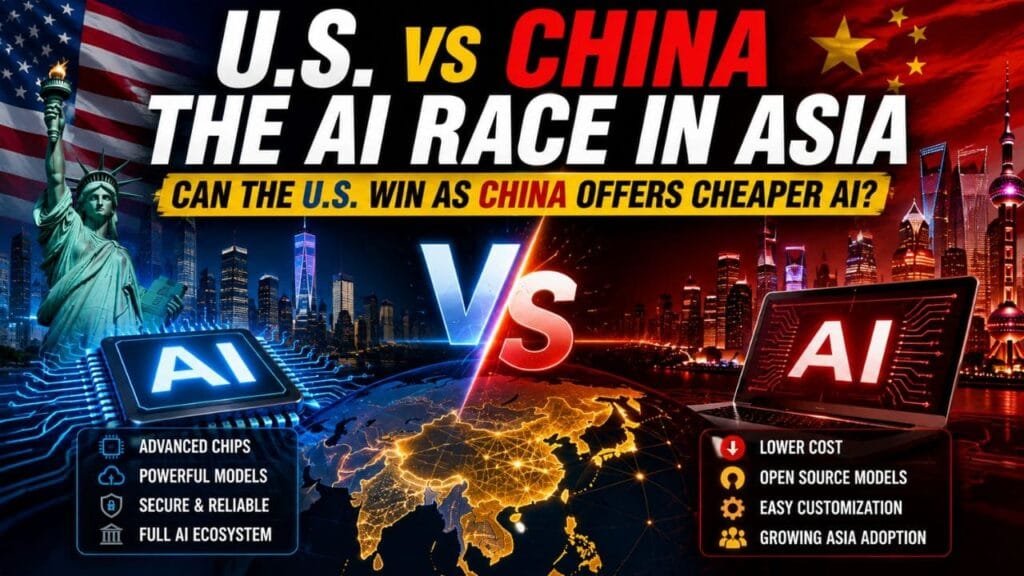
An AI system could use American chips, Chinese open-source models, local data, and software developed by a regional company.
Because of these connections, completely separating the U.S. and Chinese AI ecosystems may be difficult.
The Real Test Is Economic Value
AI adoption will ultimately depend on whether the technology produces useful results.
Governments may ask whether AI can improve public services, support education, reduce costs, or strengthen national industries.
Businesses may focus on productivity, customer service, automation, and revenue growth.
The country that provides the best technology will not necessarily win every market. Price, reliability, security, local support, and ease of use will also influence decisions.
Yue Su, a principal economist at the Economist Intelligence Unit, said the United States and China are competing through different AI technologies and diplomatic strategies, but they may not be able to separate completely from one another.
The limited U.S. presence in Chengdu may also have been influenced by other major AI events taking place at the same time.
South Korea, for example, has been expanding its investments in advanced chips and large AI projects.
President Lee Jae-myung met with leading U.S. technology executives, including OpenAI CEO Sam Altman, Anthropic CEO Dario Amodei, and Nvidia CEO Jensen Huang.
The meetings reflected South Korea’s effort to strengthen its position in both the global semiconductor industry and the rapidly growing AI economy.
Can the U.S. Compete With China’s Lower-Cost AI?
The United States continues to have major strengths.
It leads in advanced AI research, high-performance chips, cloud infrastructure, and many of the world’s most capable AI models.
China, however, is becoming more competitive by offering lower-cost models, open technology, training programs, and partnerships across Asia.
The U.S. may offer a more complete AI ecosystem, but China’s approach could be appealing to countries that want affordable technology and greater control over how it is used.
Asia is unlikely to become a market controlled entirely by one country.
Instead, governments and businesses may select AI technology based on their individual needs. Some may rely heavily on American systems, while others may use Chinese models or combine tools from both countries.
Conclusion
The competition for Asia’s AI market is becoming one of the most important parts of the wider technology rivalry between the United States and China.
American companies have an advantage in advanced chips, frontier AI models, cloud platforms, and full technology solutions. China is building influence through lower prices, open AI models, training opportunities, and regional partnerships.
For many Asian countries, the decision will not be about choosing one side forever. The more practical approach may be to combine American hardware, Chinese AI models, and locally developed technology.
The future winner may not be the country with the most powerful AI model. It may be the one that provides the strongest combination of affordability, performance, security, flexibility, and long-term economic value.
🔔 Connect With Us
Stay updated with the latest Update,
👉 Join us on WhatsApp – Link
👉 Join our Telegram Channel – Link
👉 Follow us on X (Twitter) – Link
👉 Follow us on Instagram – Link
👉 Like our Facebook Page – Link
👉 Follow us on Threads – Link
📩 Contact & Support
Have questions, feedback, support requests, collaborations, or business opportunities?
Feel free to reach out:
📧 Business Inquiries: contact@easylearnguide.com
📧 Support & General Assistance: support@easylearnguide.com
Frequently Asked Questions (FAQs)
1. Can the U.S. compete with China’s cheaper AI models?
Yes. The United States remains strong in advanced AI chips, cloud computing, frontier AI models, research, and enterprise technology. However, China’s lower-cost and open AI models may appeal to countries and businesses looking for affordable and customizable AI solutions. The competition will likely depend on price, performance, security, and long-term value.
2. Why are Chinese AI models often cheaper?
Chinese AI companies are developing efficient AI models that can be trained and operated at lower costs. Many Chinese models also use open-weight or open-source approaches, giving developers more flexibility and reducing dependence on expensive proprietary AI platforms.
3. What is the difference between U.S. AI and Chinese AI?
U.S. AI companies are known for advanced chips, powerful frontier models, cloud infrastructure, and complete AI technology ecosystems. China has gained attention for lower-cost AI models, open development, customization options, and growing adoption across Asia. Both countries have different strengths, and many organizations may use technology from both ecosystems.
4. Why is Asia important in the U.S.–China AI race?
Asia has large populations, fast-growing digital economies, expanding technology industries, and increasing investment in artificial intelligence. Countries across the region are using AI for business, education, public services, research, and economic growth, making Asia an important market for both U.S. and Chinese AI companies.
5. Will Asian countries choose U.S. AI or Chinese AI?
Many Asian countries may not choose only one. They could combine American AI chips and cloud services with Chinese open-source models and locally developed technology. Their choices may depend on cost, security, performance, local-language support, and national technology goals.
6. What role does open-source AI play in Asia?
Open-source and open-weight AI can help governments, businesses, and developers customize AI models for local languages and specific needs. It may also give countries more control over their AI systems and reduce dependence on a single foreign technology provider.
7. What will determine the winner of Asia’s AI market?
The winner may not be the country with the most powerful AI model. Important factors include affordability, performance, security, local-language support, customization, infrastructure, partnerships, and the ability to create real economic value.
These seven are more relevant than the Google AI, OpenAI, Claude AI, and AI detector questions because they stay tightly focused on your article’s main topic.
You may also like –
What Is Model Context Protocol (MCP)? How It Connects AI Models to Tools and Data
Tesla Limits Employee AI Spending to $200 Per Week, Except for Grok
AI Boom Faces a New Threat: How Severe Weather Is Disrupting Data Centers and Technology
Can AI Answer Life’s Biggest Questions? Why Not Knowing May Lead to the Truth
U.S. Approves Iranian Oil Sales as Final Peace Deal Negotiations Advance
5 AI Predictions for 2030 That Could Change the Future Forever
Jeff Bezos Says AI Will Create a Labor Shortage, Not Replace Human Workers